


Cash determines the place we reside, what we are able to afford, and the way wealth accumulates throughout generations. But the mechanisms that create and distribute it stay largely occluded, at the same time as their penalties develop into tougher to unsee. For Dutch artist Carlijn Kingma, investigative monetary journalist Thomas Bollen, and financial researcher Martijn Jeroen van der Linden, that disconnect turned the impetus for The Waterworks of Cash. This bold mission maps the hidden structure of the monetary system by way of drawing and animation, rendering it comprehensible to the folks residing inside it with out flattening its complexity.
The Waterworks of Cash depicts the monetary system as an enormous community of reservoirs, channels, and pumps, revealing how cash strikes by way of banks, governments, companies, and households. Some areas obtain an abundance of liquidity, whereas others stay perpetually dry. The ensuing drawing operates concurrently as an art work, an academic instrument, and an examination of monetary energy.
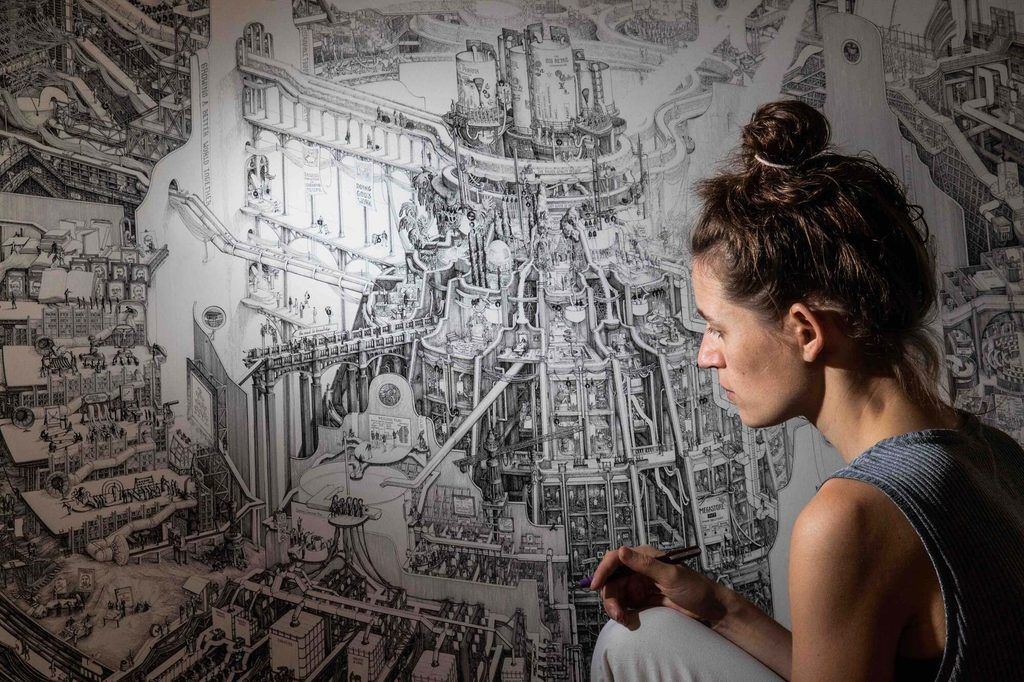
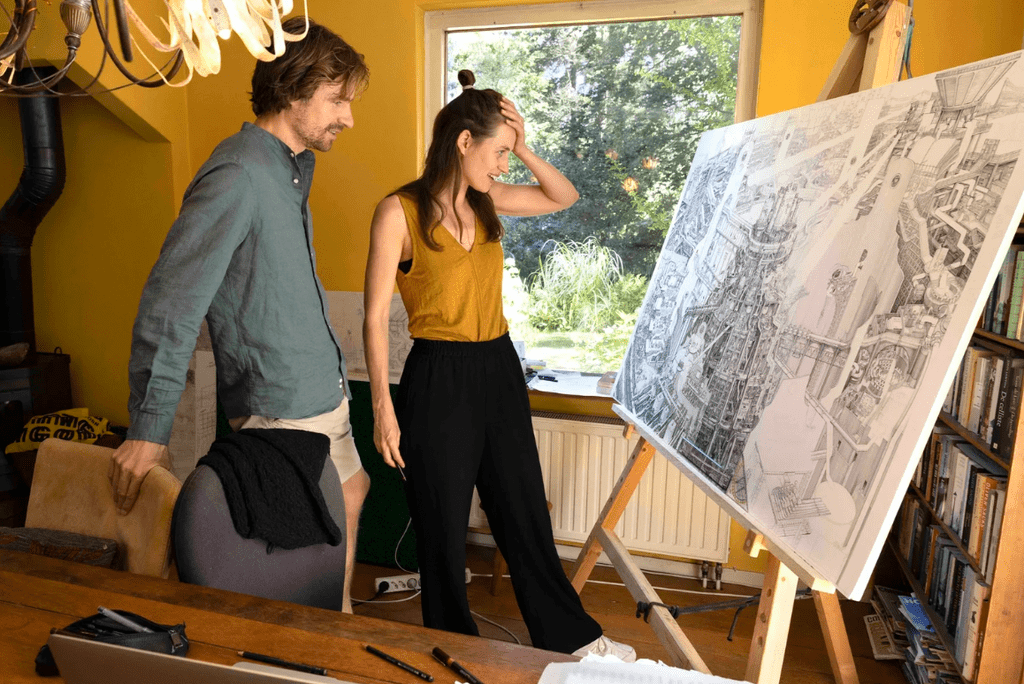
The mission emerged from two years of analysis, together with interviews with greater than 100 specialists throughout banking, authorities, academia, and financial reform actions. Kingma spent greater than 2,200 hours translating that analysis into an intricate architectural panorama. Bollen, whose investigative journalism examines the workings of the monetary system, and van der Linden, whose educational analysis explores cash and financial reform, helped develop the financial analysis and narratives behind the work.
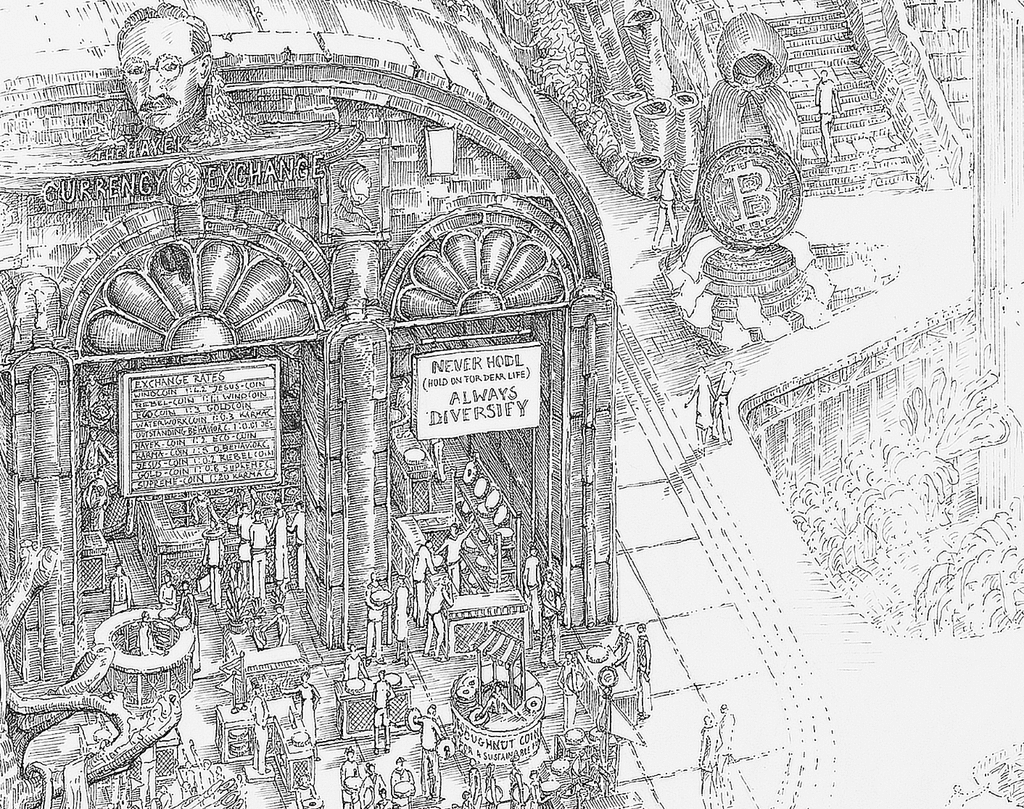
One of many mission’s eventualities explores a financial future formed by bitcoin. As bitcoin enters conventional finance, an alternate financial system both challenges present buildings of monetary energy or ultimately turns into a part of them, and the mission’s collaborators have watched each occur.
Forward of Bitcoin Amsterdam, November 5-6, the place Bollen joins two panels, I sat down with all three of the mission’s collaborators to debate getting cash seen, the connection between financial programs and inequality, and bitcoin’s place in Europe’s monetary future.

BMAG: The Waterworks of Cash illustrates the monetary system as a community of reservoirs, pumps, and channels, with some components of society receiving ample liquidity whereas others stay dry. After two years of analysis and interviews with monetary specialists, what stunned you most about how cash truly works? What do you assume the general public most basically misunderstands about it?
Thomas Bollen: What stunned me most is that many individuals contained in the system know a terrific deal about their very own nook of it: rate of interest derivatives, asset administration or mortgage lending. Only a few of them can oversee the bigger system through which they function.
What’s clearly not properly understood is that banks create new cash after they make a mortgage. They don’t seem to be simply intermediaries that go on the financial savings of their depositors.
However are you able to blame abnormal folks for that? Through the analysis part we spoke to many bankers and even a CEO of a significant financial institution who didn’t know they have been working for a cash creating establishment.
If we wish to enhance understanding we should always begin at our faculties and universities. Many textbooks nonetheless get it incorrect, and economics training hardly pays any consideration to it. In 2022 even the Riksbank’s prize in economics (the Nobel prize that isn’t actually a Nobel prize) was awarded for analysis that presents banks as mere intermediaries.
BMAG: One of many central concepts in The Waterworks of Cash is that cash doesn’t circulate evenly by way of society. Housing affordability has develop into a significant challenge in Europe and the US, whereas asset costs and monetary wealth have more and more outpaced wages. How a lot of this inequality outcomes from the design of our financial system, moderately than broader financial forces?
Thomas Bollen: It’s inconceivable to seize that in a exact quantity, as a result of so many elements play a task. However it’s fairly clear that the cash system exacerbated inequality enormously throughout all these years when credit score was extraordinarily low-cost.
Ray Dalio, founding father of the hedge fund Bridgewater Associates, summed it up in 2019: “Cash is free for many who are creditworthy.” For everybody with out cash or creditworthiness, it was out of attain.
Low-cost credit score for wealthy folks and huge multinationals (who used it for share buybacks and M&A offers) drove up the value of shares, and of homes. Financial institution cash creation produced a selected form of inflation: asset inflation. Rich households and huge multinationals, who already owned these property, profited way more from it than folks with out them or small companies that didn’t have the identical form of entry to low-cost credit score as their bigger rivals.
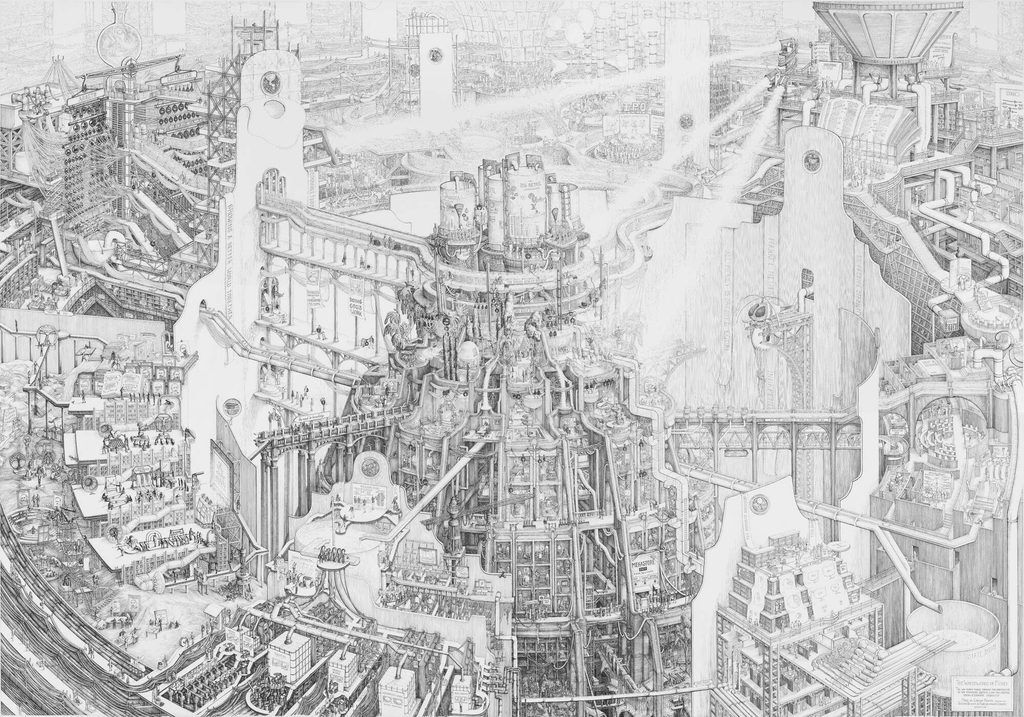
BMAG: The Waterworks of Cash is stuffed with particulars that assist clarify how the monetary system works. What was probably the most tough a part of the financial system as an instance? Did something you realized through the analysis change the way you approached the drawing?
Carlijn Kingma: The largest problem was the best way all of the components are linked. How do you present that clearly?
Water is the apparent metaphor for cash, and it takes you a good distance. Liquidity, money flows, cash drying up: they’re already within the language of finance. It was additionally nice for connecting the completely different components of the system, as a result of I might draw the pipes and canals that run between them.
However in some locations you want greater than that if you wish to be fully correct. Cash is available in many kinds: commodity cash, public cash, personal credit score cash, and additional out short-term debt and repo contracts also can function cash or near-money. It was not potential to attract that many alternative sorts of water working by way of the system.
BMAG: The Waterworks of Cash has been proven to each artwork audiences and folks thinking about economics, together with at Bitcoin Amsterdam final yr. Have you ever observed variations in how these audiences reply to the work? Has their suggestions influenced how you concentrate on the function of artwork in explaining advanced concepts?
Carlijn Kingma: The response relies on what folks already know. Guests with extra monetary information normally snigger extra, as a result of they catch all of the small jokes. We renamed Basel III to “Babel III”, as an example, as a result of the financial institution guidelines written after the disaster add as much as about three bibles.
In our bitcoin future state of affairs, The Republic of a Thousand Cash, we put in lots of jokes about central bankers. You possibly can see Alan Greenspan there as an inflatable doll. That works finest if you recognize who he’s, and the bitcoin crowd is aware of way more about financial historical past than most of the people.
Above all, we observed that artwork opens doorways. The drawing provides folks a visible place to begin for a dialog. Even with none prior information, the metaphor allows you to see the social outcomes of how cash flows.
BMAG: Your analysis has examined how monetary crises can reinforce the affect of establishments thought of too vital to fail. Extra not too long ago, you’ve explored the rising energy of asset managers corresponding to BlackRock and Vanguard. Are we witnessing a real transformation in how monetary energy operates, or have the identical underlying issues merely taken new kinds since 2008?
Martijn Jeroen van der Linden: Following the disaster of 2008, there was a common consensus amongst mainstream policymakers, assume tanks and plenty of economists that the banking sector wanted to be repaired. In Europe, the influential de Larosière Group concluded that the causes of the disaster have been extreme leverage, opaque securitisation, shadow banking dangers, and fragmented supervision within the EU, and argued that “restore is important and pressing.” The banking restore consisted of recent and stricter rules, stronger coordinated supervision and new disaster administration procedures. The underlying structure remained unaltered, which means that elementary change by no means occurred.
However the structure remained fragile. Take, for instance, 2023. When Silicon Valley Financial institution and Credit score Suisse acquired into hassle, the disaster playbooks developed after 2008 stayed within the drawer. The US authorities assured all SVB deposits, together with the greater than 90 % above the insured restrict. In Switzerland, the state backed the rescue of Credit score Suisse by UBS.
Advocates of banking restore usually declare to have made the system safer. However the inherent fragility of funding long-term loans with runnable financial institution deposits remains to be there. Even with all of the regulation, you can’t stop a financial institution run, and that fragility is exactly what they refuse to resolve. The banking system solely survives due to huge public security nets and privileges given to banks.
Massive highly effective non-banks have certainly emerged however they don’t play a pivotal function in cash and funds. It is a key distinction between the 2 sectors.
BMAG: Bitcoin started as an try and create cash outdoors the management of governments and banks. In the present day, it’s more and more held by way of funding funds and conventional monetary establishments, together with among the identical highly effective asset managers examined in your current work. Does this integration strengthen bitcoin’s capacity to alter the monetary system, or threat reproducing the focus of energy it initially sought to problem?
Martijn Jeroen van der Linden: As a monetary asset, bitcoin has benefited from investments from conventional monetary establishments. However the rising use of bitcoin as an funding has compromised its promise of an alternate fee system.
On the identical time, bitcoin and the rise of stablecoins have challenged the banks on their fee infrastructure. The banks at the moment are innovating too: take a look at Wero, the fee pockets {that a} group of European banks launched in 2024. That may be a change. However it’s one thing completely different from the structural reform of cash and banking.
BMAG: Your mission imagines bitcoin as a substitute for the prevailing financial system. Amsterdam additionally has a exceptional historical past of financial experimentation, from the event of contemporary monetary establishments to David Chaum’s pioneering work on personal digital money a long time earlier than bitcoin. Provided that historical past, how do you see bitcoin’s function in Europe’s monetary future? Has your perspective modified because you started engaged on the mission?
Thomas Bollen: What I respect about bitcoin’s design is that it resembles full reserve banking. A bitcoin will not be a declare on one thing else, so it carries no threat of a financial institution run. Financial institution deposits are: they’re a promise that you could withdraw your cash at any second, whereas the financial institution can by no means preserve that promise to all its prospects without delay.
We are able to be taught so much from our historical past. The Amsterdamsche Wisselbank, based in 1609 and infrequently seen because the world’s first central financial institution, began out as a full reserve financial institution: each financial institution guilder was backed by cash in its vault. It went below solely after it secretly started lending an increasing number of to the Dutch East India Firm.
That’s the threat of each financial experiment: it may well go within the incorrect route. Within the crypto world, every kind of corporations began copying the banks. They lent out their prospects’ bitcoins, whereas these prospects nonetheless noticed their coin-balances of their accounts. Sam Bankman-Fried’s FTX reveals how this observe can go horribly incorrect.
Thomas Bollen will take part in two panel discussions at Bitcoin Amsterdam on November 6, 2026, on the Treasury Stage. Europe’s Financial Historical past & Future: Austrian Economics, Banks & Bitcoin (11:00–11:30 AM), alongside Rahim Taghizadegan and Willem Middelkoop, and Staat vs. de Markt: Hoeveel Overheid Hebben We Nodig in Geld? (1:55–2:25 PM), alongside Paul Buitink and Simon Lelieveldt.
Watch the total two-part animated exploration of The Waterworks of Cash on YouTube and assist the mission by buying a signed, limited-edition print by Carlijn Kingma or making a donation towards its continued analysis at waterworksofmoney.com/purchase.
The Bitcoin Museum & Artwork Gallery (BMAG) organizes worldwide exhibitions, auctions, and artist collaborations exploring bitcoin and its cultural implications. Study extra at museum.b.tc.
Be a part of us at Bitcoin Amsterdam, November 5–6, 2026. Get your tickets right here and use code BA26-BMAG20 for discounted admission.

