

Key takeaways
- Spain’s Royal Decree-Regulation 44/2026 would let monetary intelligence unit Sepblac freeze crypto accounts for as much as 5 enterprise days, and halt pending transactions for as much as ten, with no court docket order.
- The powers take impact January 25, 2027, topic to parliamentary validation; a court docket should verify or prolong any suspension on the deadline.
- Sepblac and establishments that adjust to its orders are protected against legal responsibility, and the article doesn’t set out a buyer compensation mechanism.
- The decree doesn’t create a strategy to freeze Bitcoin in self-custody, however exchanges, custodians and a few stablecoin issuers can prohibit entry.
- Spain is implementing components of the EU’s 2024 anti-money laundering directive, so that is a part of a wider European shift.
Spain is tightening its crypto regulation with a brand new measure that may permit the nation’s monetary intelligence unit to freeze cryptocurrency accounts for as much as 5 enterprise days with out first acquiring a court docket order. Authorities would additionally have the ability to cease pending transactions for twice as lengthy.
The powers are contained in Royal Decree-Regulation 44/2026, dated November 24 and revealed in Spain’s Official State Gazette on Wednesday. They’re scheduled to take impact on January 25, 2027, topic to the parliamentary validation course of.
The choice comes at a time when cryptocurrency is changing into extra accessible by way of conventional monetary establishments. Bitcoinist beforehand reported on Santander’s enlargement into retail cryptocurrency companies, a part of a broader shift bringing digital property into regulated banking environments.
That comfort, nevertheless, comes with a special set of dangers for buyers. The establishment holding their cryptocurrency might also be required to forestall them from accessing it.
Spain Expands Its Authority Over Crypto Accounts
The brand new Article 46 bis of Spain’s anti-money laundering laws offers Sepblac, the nation’s monetary intelligence unit, the authority to intervene when it identifies indications of cash laundering or terrorist financing.
The measure establishes two separate limits: 5 enterprise days for accounts and enterprise relationships, and ten enterprise days for particular person transactions which might be nonetheless in progress.
These are most intervals moderately than automated detention intervals. Sepblac should elevate the restrictions sooner if they’re not essential.
Till now, the federal government’s explanatory memorandum notes, this explicit preventive energy had been restricted to requests from international monetary intelligence models. The reform permits Sepblac to behave on the premise of its personal evaluation.
For investigators, the reasoning is easy. Cryptocurrency can transfer between platforms and throughout borders lengthy earlier than a standard investigation produces outcomes. An intervention that arrives after the funds have disappeared could also be of little sensible use.
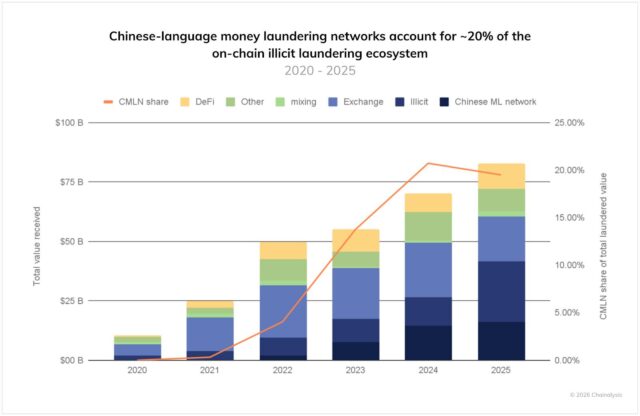
International on-chain cash laundering grew from $10 billion in 2020 to greater than $82 billion in 2025. Whereas these figures should not particular to Spain, they illustrate the broader enforcement problem going through monetary intelligence businesses.
For account holders, the harder query is what occurs when the preliminary suspicion seems to be improper.
The place Do the Courts Come In?
Spain just isn’t eradicating the courts from the method completely. It’s altering once they grow to be concerned.
A suspension should expire on the statutory deadline until a court docket confirms or extends it following a request from public prosecutors. Appeals in opposition to the ensuing judicial resolution fall below Spain’s felony process laws.
One other provision deserves explicit consideration. Article 46 bis protects Sepblac, its officers and workers, and establishments complying with its orders from legal responsibility when the suspension is carried out in accordance with the legislation.
The safety is conditional, nevertheless it raises a professional query about accountability. 5 enterprise days with out entry to funds could also be manageable for a long-term investor. For an energetic buying and selling enterprise or an organization counting on cryptocurrency to settle funds, the results may very well be significantly extra critical.
The brand new article doesn’t itself present an in depth buyer compensation mechanism for losses arising from a lawful suspension.
There’s additionally a distinction between freezing property and confiscating them. A short lived restriction preserves funds throughout an investigation; it doesn’t set up that their proprietor has dedicated a criminal offense.
Can Spain Freeze Bitcoin Held in a Non-public Pockets?
The sensible attain of the reform relies upon partly on how an investor shops their cryptocurrency.
A centralized alternate or regulated custodian controls entry to the property it holds on behalf of consumers. It could due to this fact prohibit withdrawals or block transactions in response to a legally binding instruction.
Bitcoin held instantly by an investor presents a special technical state of affairs. The community has no central administrator able to disabling an unusual Bitcoin handle on the request of a monetary intelligence company.
The decree doesn’t introduce such a mechanism.
Self-custody shouldn’t, nevertheless, be confused with immunity from authorized motion. Authorities can pursue property by way of different lawful procedures, whereas some centrally issued stablecoins have technical options that permit their issuers to limit transfers.
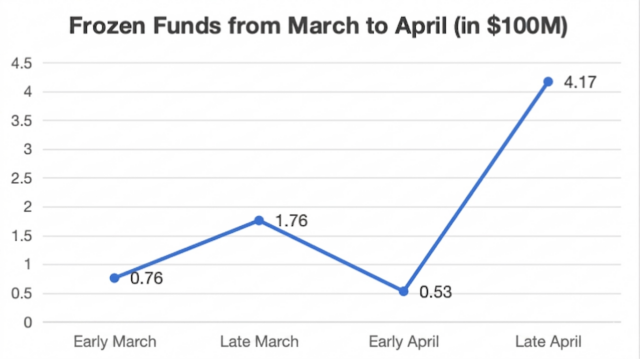
Analysis from blockchain safety agency Beosin reveals the size of those present controls. Between March and April 2026, roughly $722 million in USDT and USDC was frozen throughout 1,397 blockchain addresses. These restrictions illustrate the technical authority stablecoin issuers already possess, independently of Spain’s new laws.
The excellence issues as a result of proudly owning cryptocurrency and having unrestricted entry to it should not essentially the identical factor.
Spain’s Determination Is A part of a Wider European Shift
The Spanish reform implements components of the European Union’s 2024 anti-money laundering directive, which establishes frequent necessities for the powers of nationwide monetary intelligence models.
The directive explains that short-term suspensions are meant to “protect the funds, perform the mandatory analyses,” permitting investigators to find out whether or not their suspicions are justified.
Spain’s transfer ought to due to this fact be understood in a broader European context moderately than as an remoted nationwide crackdown on cryptocurrency.
The subsequent vital milestone is parliamentary validation. Below Article 86 of the Spanish Structure, royal decree-laws have to be submitted to Congress inside 30 days of their promulgation.
If the measure proceeds as scheduled, Spain’s monetary intelligence unit will enter 2027 with higher authority to intervene in suspicious cryptocurrency exercise.
How that authority is exercised, notably when harmless clients are caught in an investigation, shall be simply as vital because the laws itself.

Editorial Course of for bitcoinist is centered on delivering totally researched, correct, and unbiased content material. We uphold strict sourcing requirements, and every web page undergoes diligent assessment by our staff of prime expertise specialists and seasoned editors. This course of ensures the integrity, relevance, and worth of our content material for our readers.

